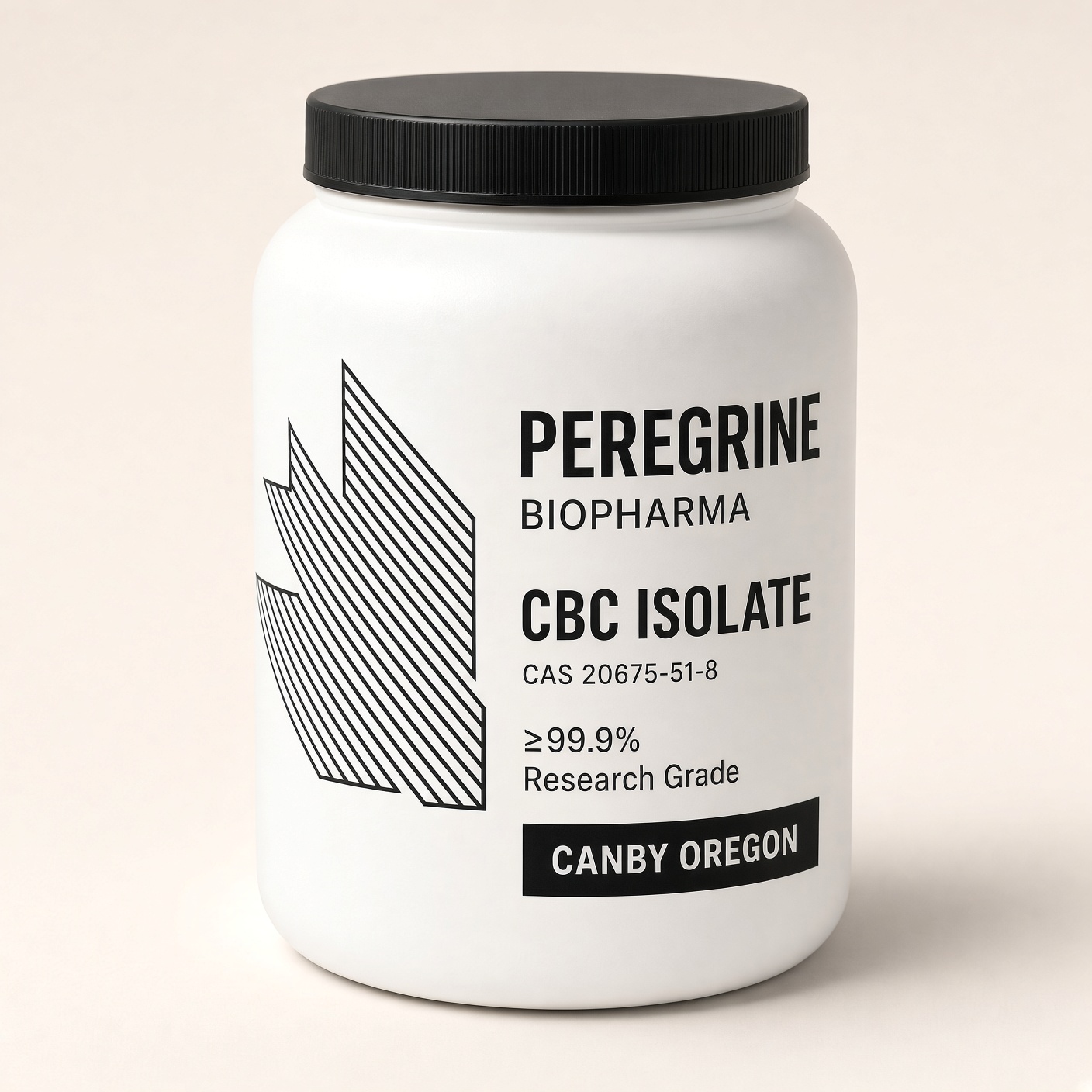
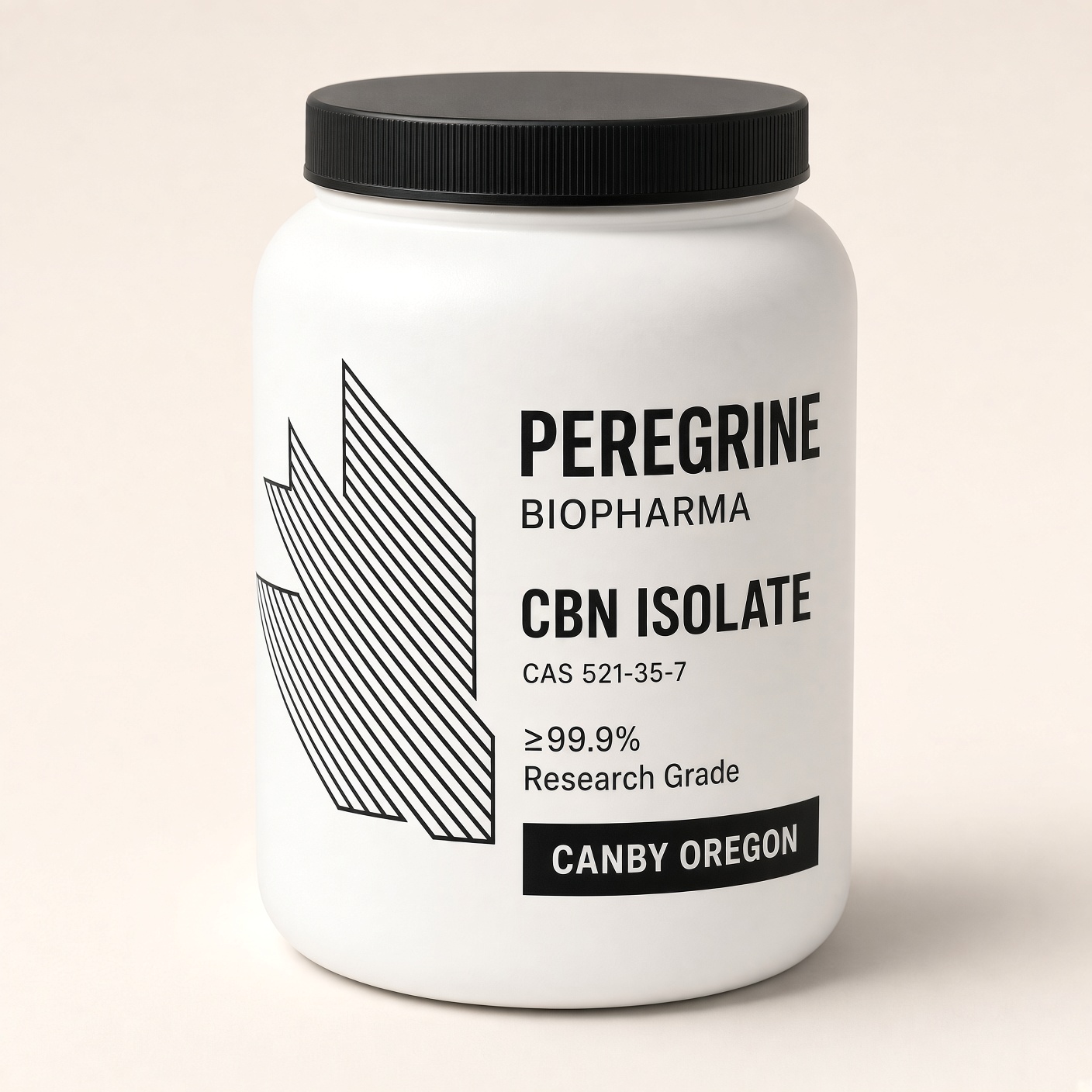
CBNC21H26O2310.43 g/mol
CBN isolate (≥99.9%)
CAS 521-35-7
5 g – 100 g · Contact for pricing
Request pricing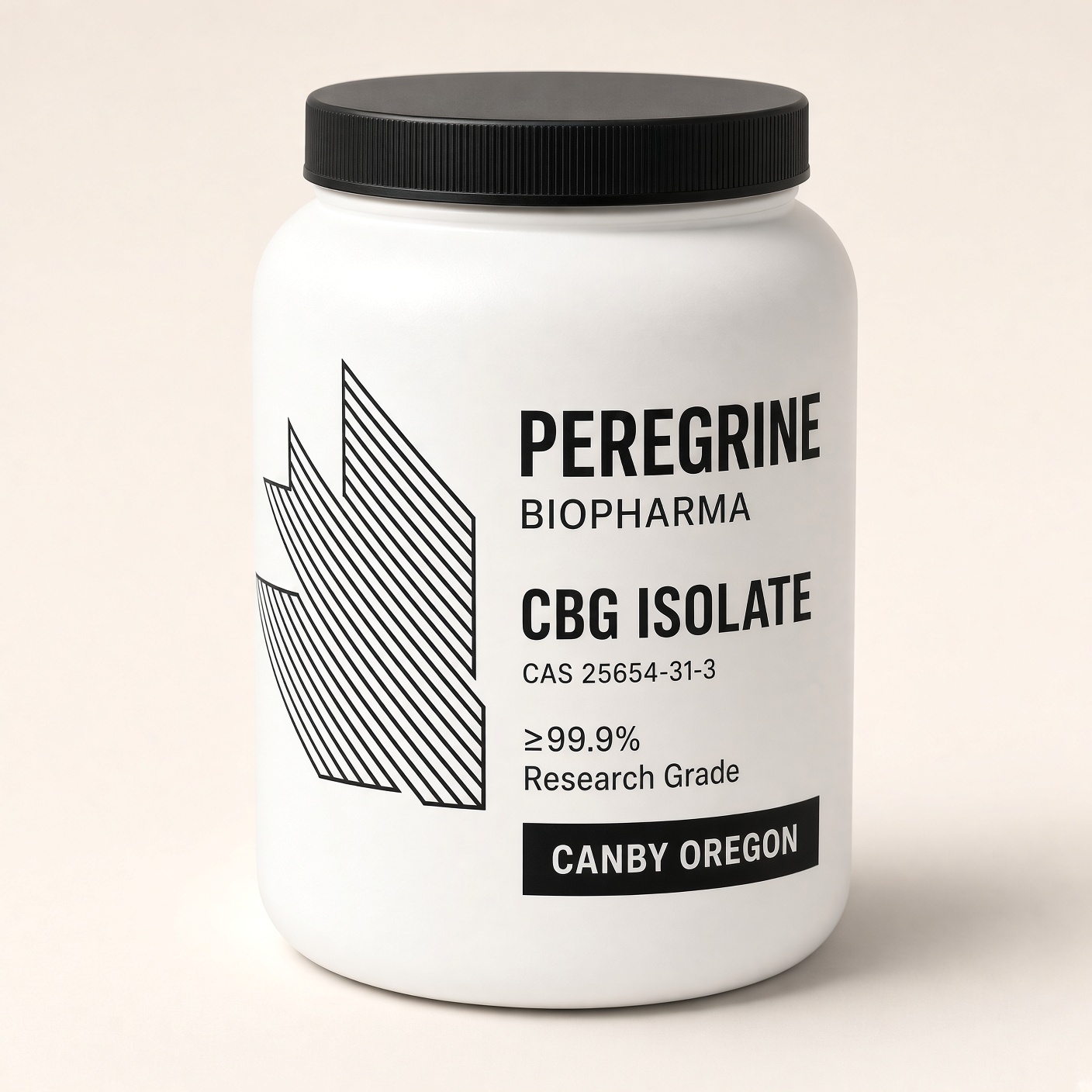
CAS 25654-31-3
5 g – 1 kg · Contact for pricing
CBG (cannabigerol) is a non-intoxicating phytocannabinoid. Its acid, CBGA, is the single precursor that three plant synthases branch into the THC, CBD and CBC lines. Neutral CBG is the decarboxylated form of that parent acid, which is why it is called the mother cannabinoid.
Specification sheet (PDF) · one page, forwardable; the lot COA carries the measured values
Masses
Selected 5 g. Request below.
How we sell
01
Tell us the compound, the mass, and the destination, and give us a work email. We don’t publish prices because they depend on the lot.
02
A person replies within one business day with the available lot, lead time, and price.
03
You confirm the mass and destination on a purchase order. There is no consumer checkout.
04
The pack ships with the COA covering identity and assay if you asked for it. An SDS is available on request.
CBG isolate · 5 g · one business day
CBG is the decarboxylated form of CBGA. Store cool, dry, and protected from light. Assay by HPLC-UV or LC-MS against a qualified reference.
Multi-product or full procurement details? Use the procurement form.
Buying guide
Bulk CBG isolate is cannabigerol (CAS 25654-31-3, C21H32O2) purified to ≥99.9% and supplied as a crystalline solid. Peregrine sells it as an ingredient from 5 g research cuts to 100 kg campaign lots, with identity and assay on a per-lot COA and an SDS on request. It is the neutral, decarboxylated form of CBGa, stored ambient, dry and dark. Quotes return in one business day; destination jurisdiction is required on every inquiry.
CBG is present at low abundance in most hemp chemovars, so producers typically start from a CBG-dominant cultivar or from CBGa-rich biomass. The workflow most labs follow is extraction (ethanol or CO₂), winterisation to remove waxes, decarboxylation of CBGa to CBG, then chromatographic enrichment and repeated crystallisation until the named cannabinoid is the only species above the reporting limit.
Purity above 99.9% is a crystallisation result, not an extraction result. The last crystallisation steps are where minor cannabinoids, residual solvent and colour are removed — which is why residual-solvent data belongs on a COA rather than on a marketing page.
Identity and assay for the named cannabinoid, at minimum. Identity is HPLC against a qualified reference standard; when a primary standard is on allocation, Peregrine discloses NMR or LC-MS identity on the COA rather than implying HPLC. Assay is reported as percent w/w of CBG, and a lot is listed as Available only after both clear.
Residual-solvent (ICH Q3C classes as applicable to the process), heavy-metal and pesticide panels ship with the lot pack when you request them on the inquiry. Appearance, water activity, storage condition and origin are lot-specific and printed on the COA, not on this page.
Ambient, dry and protected from light unless the COA says otherwise. Keep the food-grade container closed between weighings; the crystalline solid is not hygroscopic in the way a spray-dried powder is, but repeated opening in a humid room still changes water activity.
For formulation, CBG dissolves in lipids, ethanol and most cosmetic oil phases and is practically insoluble in water. Weigh by assay, not by gross mass, when the COA reports less than 100% — the difference matters at kilogram scale.
Pick a mass on this page, add the destination jurisdiction, and send the inquiry. A person answers with a quote in one business day. For CBG isolate, 5 g, 100 g and 1 kg are quoted today; every larger mass stays Coming Soon until a campaign is scheduled and the lot clears release.
Every mass tier shows one of three states: Available (identity and assay have cleared), Contact for pricing (a human quotes the campaign), or Coming Soon (we cannot take the order until the lot exists). Incoterms, carrier and pickup window are on the quote. For multi-product requests use the procurement form on /quote.
Compare: CBG vs CBD: what’s the difference · CBG vs CBGa: acid or neutral · CBG vs CBN: what’s the difference · Cannabinoid isolate vs distillate · How to read a COA · Storage
≥99.9% cannabigerol by HPLC, reported as percent w/w on the lot COA. Identity is confirmed against a qualified reference standard.
At ≥99.9% assay every other cannabinoid is below the lab's reporting limit on the lot tested. Read the actual value on the COA rather than a page claim; destination rules on Δ9-THC are yours to confirm.
5 g is the research cut. 100 g is the first campaign step. Kilogram tiers are quoted by a person.
Yes. The 5 g research cut ships with identity and assay on the COA so your lab can qualify the material first.
One business day from a complete inquiry with destination jurisdiction. Lead time and Incoterms are on the quote itself.
Strictly, the acid is. CBGA is the precursor the plant branches from, and CBG is the neutral form left after decarboxylation. The nickname carries over to CBG because it is the same skeleton without the carboxyl group.
No. CBG is not Δ9-THC, and in laboratory work it antagonises CB1 rather than activating it, which is the chemistry behind calling it non-intoxicating. That is a receptor description, not a wellness claim.
Yes, one: Cuttler et al. 2024, an acute placebo-controlled crossover in 34 healthy adults, graded Low by CBG Atlas. It was not a disease trial and Peregrine did not run it. The CBG human-trial page walks through the design.
Yes. We sell wholesale CBG isolate from 5 g to 100 kg; contact us for pricing.